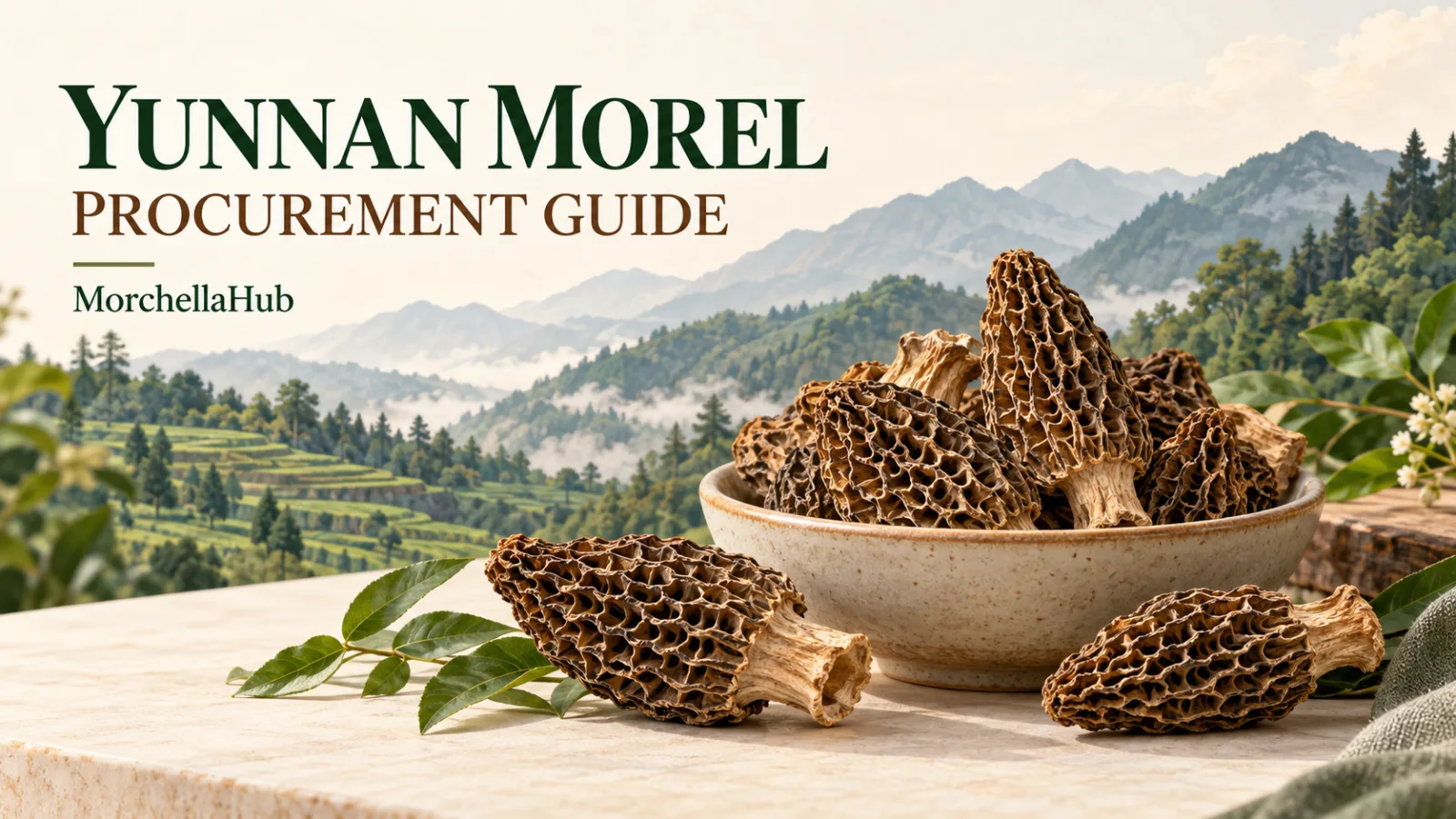
An Indian buyer evaluating Yunnan dried morels should begin with product identity, not a familiar mushroom name. A quotation for cultivated Chinese-origin morels is not a quotation for wild Himalayan guchhi. Both the origin and the proposed sourcing type should be explicit on the sample request and commercial paperwork, so a hotel, distributor or retailer can compare the offer honestly.
Separate imported Yunnan stock from locally described guchhi
A useful first discussion separates three businesses: a hotel buying whole caps, an ingredient distributor buying bulk stock, and a retailer preparing consumer packs. They may need different pack sizes and evidence. Start with one defined use and city rather than interpreting India's large population as a ready-made premium mushroom market. Delhi, Mumbai or Bengaluru can be named as receiving destinations in an RFQ without implying that the supplier has warehouses or guaranteed routes there.
Importer checks before dispatch
FSSAI describes food-import clearance through FICS integrated with Customs. Ask the Indian importer or customs adviser to confirm the applicable food classification, importer authorizations, label review and clearance route for the actual dried product. Resolve whether any additional plant-quarantine checks apply rather than copying requirements for a different mushroom form. Commercial samples should be assessed as imports, not casually described as personal gifts.
Sources for this section, checked 29 October 2026: FSSAI food import informationFSSAI Food Import Clearance System[https://www.fssai.gov.in/fics](. Requirements must be rechecked for the actual product and shipment.)
Choose a lot and grade for the application
For a stuffed-cap application, request dry cap-only dimensions, the permitted stem length and a representative intactness sample. For a cooked sauce, ask for a separately specified acceptable pieces grade. Do not pay for a wild-origin story unless it is genuine and supported; MorchellaHub's proposed offer should describe its Yunnan cooperating-grower sourcing accurately.
Packing, labels and the receiving route
Have the consignee review the label and importer details before printing retail packs. Compare the complete delivered cost, including clearance work and the final domestic leg. A quote to an airport or port is not automatically a price delivered to a restaurant's receiving room.
Cooking and menu evaluation
A chef might trial morels in a thoroughly cooked rice, gravy or stuffed preparation, but this is a menu-development option rather than a claim about universal Indian eating habits. If a vegetarian claim is intended, review the stock and filling as well as the mushroom. Do not infer therapeutic benefits from a traditional ingredient name.
Morels should not be served raw or lightly cooked. Follow appropriate product and kitchen instructions; cooking reduces risk but is not a guarantee against every issue. See the FDA morel investigation
A practical first-order workflow
Send a brief for one hotel recipe: named receiving city, monthly dry-weight requirement, cap band, stem treatment and whether stock is for filling or chopping. Ask the importer to approve the intended import and label pathway before the supplier packs the trial. Compare the sample with a retained reference when the commercial lot arrives.
- Define the importer and the final receiving city.
- Describe the dry weight, cap band, stem treatment and intended application.
- Review the actual lot sample and the importer’s document checklist separately.
- Confirm the delivery basis, packing and responsibilities in the quotation.
- Keep a reference sample and check the delivered lot before release to use.
Frequently asked questions
Are Yunnan morels the same as Indian wild guchhi?
Do not treat them as interchangeable origin or sourcing claims. Confirm the supplied identity, cultivated or wild description and lot records. Judge suitability in the intended dish while describing the product's actual source honestly.
Can I request a live price for delivery to India?
Send the destination city, estimated dry-weight quantity, grade, packing and intended use. Ask which lot and documents can actually be offered. This guide supplies no fixed price, duty rate, guaranteed delivery time or automatic customs clearance. Availability and transaction feasibility must be confirmed individually.
Should the whole-cap grade also be used for sauces?
Not automatically. Compare accepted portions and handling loss in the intended dish. A defined pieces grade can be evaluated separately where appearance is less important, provided it meets the relevant identity, quality and safety requirements. Do not use material rejected for deterioration or safety.
Related specification and sourcing guides
- Wild Versus Cultivated Morels: A Commercial Comparison
- 3–5 cm, 5–7 cm and Larger Morels: Specify Cap Size
- Morel Sample Evaluation: A Practical Supplier Trial
- Pakistan procurement guide
- Bangladesh procurement guide
- All country procurement guides